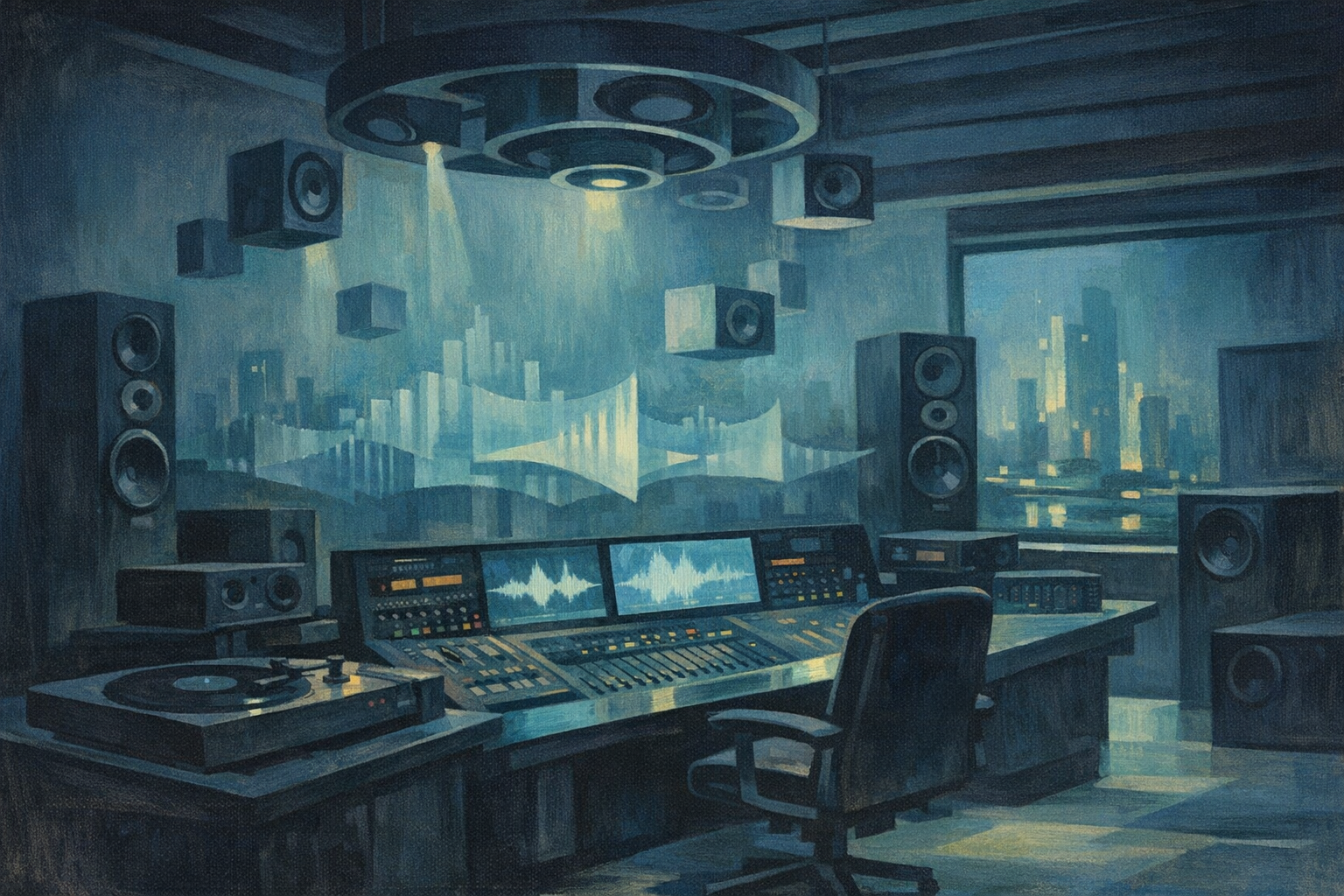
Dolby Atmos mixing has moved from premium add-on to baseline expectation faster than much of the industry wants to admit. Music platforms, film distributors, game studios, and brands now expect immersive deliverables that translate across headphones, soundbars, cinemas, and mobile devices. If your workflow still treats Dolby Atmos mixing as an experimental side project, you are already behind the market.
Table of Contents
- Why Dolby Atmos Mixing Became a Mainstream Requirement
- What Actually Makes a Great Atmos Mix
- Tools, DAWs, and Delivery Chains That Matter
- Streaming Platforms, Binaural Translation, and Format Reality
- Atmos for Film, Games, and Immersive Media
- Common Mistakes That Ruin Spatial Audio Projects
- Frequently Asked Questions
Why Dolby Atmos Mixing Became a Mainstream Requirement
The old argument that immersive audio is “nice to have” no longer survives contact with the real market. Apple Music pushed spatial listening into the mainstream, streaming services normalized immersive labels as consumer-facing features, and filmmakers, advertisers, and game developers began expecting deliverables that can scale across multiple playback environments. What changed is not only technology. Audience expectation changed.
For years, stereo remained the unquestioned center of audio production because it was practical, predictable, and universally compatible. That logic still matters, but it is no longer enough. Dolby Atmos mixing offers something stereo cannot: controllable dimensionality. Instead of squeezing every emotional cue into a left-right field, mixers can place sounds in a three-dimensional environment that feels more cinematic, more precise, and often more natural when handled correctly.
That does not mean every project needs constant overhead movement or exaggerated effects. The strongest Atmos work is usually disciplined, not flashy. In music, it may mean cleaner vocal focus, a more convincing sense of depth, and better separation between harmonic layers. In post-production, it can mean improved spatial storytelling and clearer dialogue support. In branded content and trailers, it can mean impact without frequency clutter.
Clients also care about flexibility. A modern production may need:
- an immersive master for premium streaming delivery,
- a stereo version that remains artistically consistent,
- alternate loudness targets for broadcast or OTT,
- headphone-optimized rendering for mobile users,
- and archival session management for future re-versioning.
This is where professional process matters more than hype. Immersive work falls apart quickly when teams treat Atmos as a plugin preset instead of an end-to-end production language. At DPM Production, projects that move smoothly usually begin with realistic deliverable planning and session design, not last-minute upmix panic. That is exactly why so many clients seek DPM Production’s audio post-production services when they need immersive results that are technically clean and commercially usable.
What Actually Makes a Great Atmos Mix
A great Atmos mix is not defined by how many sounds move above your head. It is defined by whether space improves communication, emotion, and translation. Too many weak immersive mixes confuse activity with quality. They throw stems into the room, automate movement for the sake of movement, and call it innovation. That is not immersive storytelling. That is expensive distraction.
Start with hierarchy, not spectacle
Every successful mix has a priority structure. In music, that is usually vocal, groove, low-end integrity, and emotional support from arrangement layers. In film and episodic work, dialogue typically remains king, with effects and score serving narrative tension. Atmos expands the stage, but it does not cancel hierarchy. If your center of attention is unclear, more dimensions will only expose the problem faster.
Objects are powerful, but restraint wins
Dolby Atmos mixing allows the use of beds and objects, creating a far more nuanced field than channel-based formats alone. But not everything deserves object treatment. Over-objectification is one of the most common signs of inexperienced immersive mixing. Core elements that should feel coherent and grounded often work better in stable bed structures, while transient, featured, or narrative elements may benefit from object-based placement and motion.
Binaural monitoring is not optional
Many listeners will first encounter your Atmos mix through headphones. That means binaural render behavior is not a side note. It is central to commercial translation. If your mix only works in a speaker room, you are mixing for a minority of end users. Engineers need to evaluate how near, mid, and far binaural settings affect localization, tonal balance, and vocal intelligibility.
That is especially true in music, where excessive width and diffuse ambience can weaken the emotional center. A vocal that feels intimate and focused in a treated room may become detached or phasey in headphone rendering if spatial choices are careless. Professional review across multiple monitoring scenarios, including dedicated rooms and reliable headphone references, is no longer a luxury. It is workflow discipline. You can see how serious facilities approach these environments by exploring our professional studio.
Low end still needs discipline
Immersive does not excuse muddy bass management. In fact, Atmos makes low-frequency mistakes easier to hear because the rest of the soundfield can become so open. If kick, bass, synth sub, or LFE content is not tightly controlled, the whole presentation loses authority. Great Atmos mixers preserve power by being conservative with low-frequency spatialization and rigorous about phase coherence and downmix behavior.
The future of immersive audio will not be won by the mixers who move the most sounds. It will be won by the mixers who make spatial decisions feel inevitable.
— DPM Production
Tools, DAWs, and Delivery Chains That Matter
The industry loves tool debates, but clients pay for reliable outcomes. Pro Tools, Nuendo, Logic Pro, and other ecosystems all play legitimate roles in immersive production. The better question is not “Which DAW is best?” but “Which DAW supports the deliverable, collaboration model, and monitoring architecture your project actually needs?”
DAW strengths in real-world immersive work
| Platform/Tool | Primary Strength | Best Fit | Common Limitation |
|---|---|---|---|
| Pro Tools Ultimate + Dolby Atmos Renderer | Industry-standard post workflow and session exchange | Film, TV, premium post-production | Higher complexity and system cost |
| Steinberg Nuendo | Strong native immersive and game audio integration | Post, game audio, broadcast | Collaboration can vary by studio ecosystem |
| Logic Pro | Accessible Atmos music workflow | Music production, songwriting, pre-mix development | Less dominant in large-scale post pipelines |
| Dolby Atmos Renderer | Authoring, monitoring, and ADM delivery control | All professional Atmos finishing workflows | Requires technical fluency to avoid routing errors |
For music creators, Logic Pro lowered the barrier to entry by making immersive authoring more approachable. That was good for adoption, but it also created a flood of mediocre Atmos releases. Access is not the same thing as mastery. A template can create an Atmos file. It cannot make arrangement decisions, fix translation issues, or manage dynamic impact across devices.
Plugins and processing choices
The same quality standards apply to plugins. Reverbs, delays, spatial enhancers, dynamic processors, and metering suites all need to be selected for immersive compatibility rather than stereo habit. Some stereo widening processors become actively harmful in Atmos because they blur positional intent. If a plugin makes everything feel bigger but nothing feel placeable, it is solving the wrong problem.
Utility tools are also essential. Clean conversion, conforming, and metadata-aware workflows save time and prevent expensive delivery errors. When teams need efficient adaptation between formats, tools such as the Dolby Atmos Converter can support practical workflow needs without compromising technical integrity.
Why workflow design beats gear obsession
The glamorous part of immersive production is the room. The unglamorous part is asset management, version control, renderer configuration, naming conventions, stem discipline, and review approval structure. That unglamorous part is where good projects survive. Studios with deep technical capability do not just own hardware. They build repeatable systems. That is one reason clients increasingly rely on our team of specialists for projects that require more than a one-off mix.
Streaming Platforms, Binaural Translation, and Format Reality
Streaming made immersive audio visible, but it also made confusion scale globally. Not every platform treats immersive audio the same way, and not every listener hears the same rendering path. Apple Music, Tidal, Amazon Music, Netflix, and device manufacturers all influence how an Atmos mix is experienced. Engineers who ignore platform behavior are effectively surrendering quality control.
The platform badge is not the finish line
Many producers chase the “Available in Dolby Atmos” badge as if it were the final creative achievement. It is not. That badge only proves a format was delivered, not that the listening experience is excellent. On headphone-centric platforms, the binaural render often defines consumer perception more than the speaker room did. A technically valid file can still sound underwhelming, hollow, or over-diffused to the average listener.
Loudness, dynamics, and translation
Immersive mixes need dynamic intention, but they also need competitive clarity. Heavy-handed loudness chasing can flatten the spatial field and reduce depth cues. On the other hand, underpowered immersive masters often feel polite and emotionally distant next to stronger catalog releases. The right target is not “as loud as possible” or “as dynamic as possible.” It is “as convincing as possible.”
That balance requires comparative listening and platform-aware review. Experienced engineers test not just in calibrated rooms, but through consumer headphones, earbuds, smart speakers, and television playback chains. For teams developing broader immersive workflows, tools like our audio tools and products and specialized capture solutions such as IR Studio Recorder can support more accurate production and evaluation pipelines.
Atmos versus other immersive formats
Dolby Atmos remains the most commercially visible format, but it is not the only immersive language worth knowing. MPEG-H has relevance in broadcast and interactive environments. Ambisonics remains central in VR and certain spatial capture applications. Game engines often introduce their own spatialization layers on top of authored content. Professionals do not need format tribalism. They need format fluency.
That is why the strongest studios build adaptable knowledge rather than single-format dependence. You can see how immersive approaches are applied across different project types by browsing our portfolio, where format and creative intent must align rather than compete.
Atmos for Film, Games, and Immersive Media
Music may have popularized Atmos for many listeners, but film, games, and XR are where immersive audio proves its deeper value. In these formats, space is not decoration. It is part of narrative logic, user orientation, and emotional control.
Film and episodic storytelling
In long-form post-production, Atmos can create a more believable world without making the mix feel self-conscious. Rooms breathe. Environments connect. Off-screen action gains definition. Score can expand without masking dialogue. The best cinematic Atmos mixes do not constantly announce themselves. They make the story feel larger than the speakers.
That subtlety matters because post-production is an ecosystem. Dialogue editing, ADR, Foley, sound design, ambiences, score, print mastering, and deliverables all interact. An immersive mix cannot be separated from editorial quality. If the source material is inconsistent, Atmos will reveal that inconsistency mercilessly. Strong facilities solve these issues upstream with coordinated post pipelines, not by hoping the final render will hide them.
Games, VR, and XR demand interactivity
Interactive media introduces a different challenge: the listener is not fixed. The player moves, rotates, triggers events, and changes perspective. That means authored immersive content often needs to coexist with middleware and engine-based spatialization systems. Anyone treating game audio like a static film mix is misunderstanding the medium.
Formats such as Ambisonics, object-based workflows, and platform-specific renderers matter because they support dynamic playback contexts. In VR and XR, head tracking, environmental response, and scene-based audio become critical. Spatial decisions must remain believable as the user changes orientation in real time. That requires collaboration between sound designers, technical audio teams, and implementation specialists from the start.
Advertising and branded immersive content
Brands are also experimenting more aggressively with immersive formats for launches, installations, and premium digital content. Here, the temptation is often to overproduce. But the strongest brand experiences use immersive audio to control focus, not just to show off. A product reveal with precise spatial staging can feel premium. A chaotic 360-degree gimmick often feels cheap.
Studios that understand both storytelling and technical execution have an advantage here. If you want broader perspective on evolving production trends, techniques, and case studies, you can always read more on our blog.
Common Mistakes That Ruin Spatial Audio Projects
Most failed Atmos projects do not fail because the format is difficult. They fail because the workflow is unserious. The same avoidable mistakes appear again and again across music, post, and interactive audio.
1. Treating stereo stems as a shortcut to immersive quality
Dropping stereo stems into an Atmos session and spreading them around the room is not a meaningful immersive strategy. It may create width, but it rarely creates depth, intent, or translation. Atmos rewards arrangement thinking and source separation.
2. Ignoring downmix and fold-down behavior
Many listeners will still hear stereo or binaural versions derived from the immersive master. If those render paths are not reviewed carefully, key elements may shift in level, feel disconnected, or lose emotional focus. An immersive mix that collapses poorly is not finished.
3. Overusing motion
Movement should communicate story, energy, or contrast. Constant motion creates listener fatigue and weakens impact. The most powerful automation often appears in moments of transition, emphasis, or narrative change. If everything moves, nothing feels special.
4. Building sessions without deliverables in mind
Engineers often get deep into creative work before clarifying platform specs, ADM requirements, loudness expectations, localization needs, or versioning demands. That leads to rework. Professional immersive production starts with delivery logic.
5. Assuming one room equals universal truth
Even excellent rooms represent only part of the playback reality. Translation checks across headphones and consumer devices remain essential, especially for streaming-focused releases. Confidence comes from cross-environment validation, not room loyalty.
Teams that want to avoid these traps benefit from experienced oversight early in the process. Whether the project is a song, a film, a trailer, or an immersive branded experience, it helps to get in touch with our team before technical debt starts dictating creative choices.
Frequently Asked Questions
Q: What is Dolby Atmos mixing in simple terms?
Dolby Atmos mixing is a method of creating audio in a three-dimensional space rather than only left and right stereo channels. It uses a combination of channel-based beds and movable audio objects to place sounds around and above the listener. The result can feel more immersive, clearer, and more cinematic when mixed properly.
Q: Do I need a full speaker room to create an Atmos mix?
You can begin exploring Atmos with headphone-based and software-assisted workflows, but serious professional delivery benefits from a calibrated monitoring environment. A proper room helps with positional accuracy, low-end judgment, and translation decisions. Headphone review is still essential because many end users listen binaurally.
Q: Is Dolby Atmos only useful for music streaming?
No. Dolby Atmos is highly relevant for film, episodic content, trailers, games, installations, and immersive brand experiences. Music streaming made the format more visible, but post-production and interactive media remain major areas where spatial storytelling has practical value.
Q: Can I convert a stereo mix into Atmos automatically?
You can generate an Atmos-compatible version from stereo material, but automatic conversion is not the same as a thoughtfully built immersive mix. Strong results usually require source separation, spatial planning, and careful monitoring of binaural and downmix behavior. Automation can speed workflow, but it does not replace creative and technical judgment.
Q: Which DAW is best for Dolby Atmos mixing?
The best DAW depends on the project. Pro Tools Ultimate is still dominant in high-end post-production, Nuendo is strong for post and game audio, and Logic Pro has become popular for immersive music workflows. The real priority is a reliable delivery chain, accurate monitoring, and an engineer who understands translation.
Q: How do I know if my Atmos mix will translate well on headphones?
You need to audition the binaural render on trusted headphones and compare it against speaker playback and stereo fold-downs. Pay close attention to vocal focus, reverb spread, low-end stability, and whether important elements feel detached or overly diffuse. Translation is a testing process, not a guess.
Dolby Atmos mixing is no longer defined by novelty. It is defined by execution. The market now rewards engineers and studios that can combine immersive creativity with disciplined delivery, platform awareness, and translation control. The winners will not be the loudest evangelists. They will be the teams that make immersive audio feel natural, reliable, and commercially effective.
That is where experience matters. DPM Production works at the point where creative ambition meets technical accountability, from spatial music and post-production to specialized tools and workflow support. If your project demands immersive audio that holds up beyond the demo room, the smartest move is to build it with people who understand both the art and the infrastructure behind it.
Whether you are preparing a streaming release, finishing a film, or planning an interactive experience, the challenge is the same: make the format serve the story instead of distracting from it. If you want a partner who can help shape that process from concept to final delivery, DPM Production is ready to support every stage with precision and clarity.
Ready to Take Your Audio to the Next Level?
Whether you’re mixing in Dolby Atmos for the first time or need expert spatial audio post-production for your next project, DPM Production has the studio, tools, and expertise to deliver world-class results.
👉 Explore Our Services
|
👉 Contact Us Today
|
👉 See Our Studio