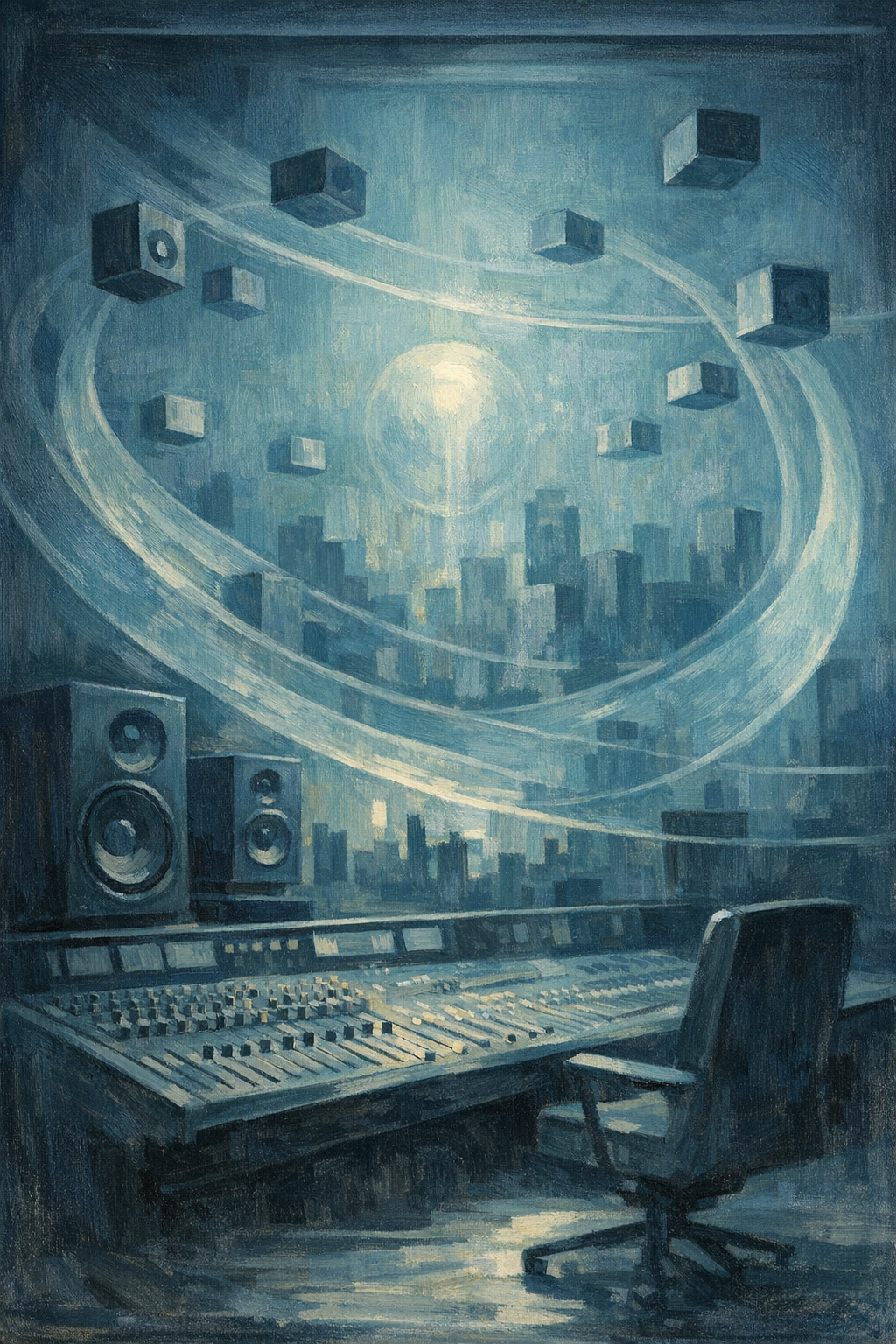
Dolby Atmos mixing is no longer a premium niche reserved for blockbuster films and superstar albums. It is fast becoming the format that separates future-ready productions from stereo-only releases that already sound dated on modern platforms. As Apple Music, Tidal, Amazon Music, Netflix, and immersive gaming pipelines continue to normalize spatial playback, Dolby Atmos mixing and mastering has shifted from optional upgrade to strategic necessity for music producers, post houses, and content owners who want their work to travel.
Table of Contents
- Why Dolby Atmos Mixing Matters More Than Ever
- What Actually Changes in an Atmos Workflow
- Platforms, Deliverables, and the Streaming Reality Check
- The Tools Shaping Modern Spatial Audio Production
- Common Mistakes That Ruin Immersive Mixes
- Where Atmos Is Headed in Music, Post, and Interactive Media
- Frequently Asked Questions
Why Dolby Atmos Mixing Matters More Than Ever
The old argument that “most people still listen in stereo” misses the point. People may still encounter stereo every day, but distribution ecosystems are increasingly designed around adaptive playback, binaural rendering, soundbars, smart TVs, headphones with head tracking, and immersive home entertainment. That means a well-built Atmos master is not just a theatrical luxury. It is a flexible delivery asset for a fragmented playback world.
The market has moved faster than many studios expected
Streaming services have trained listeners to expect more than simple left-right imaging. Apple Spatial Audio pushed the conversation into the mainstream. Tidal and Amazon Music reinforced that immersive releases are now part of catalog strategy, not a novelty campaign. In film and episodic content, Atmos is already a serious expectation. In games, VR, and XR, object-based audio is even more valuable because interactivity rewards precision and depth.
Studios that still treat Atmos as an experimental side service are behind. The practical question is no longer whether immersive audio matters. The real question is whether your production chain can create mixes that translate across headphones, soundbars, cinema rooms, mobile devices, and platform-specific encoding paths without collapsing into gimmickry.
Atmos is not just “more speakers”
Too many conversations about Dolby Atmos mixing still reduce the format to channel count. That is lazy thinking. Atmos is powerful because it combines beds and objects, which allows mixers to place, automate, and preserve spatial intent in ways stereo simply cannot. The result is not automatically better audio, but it opens creative and editorial options that are impossible to ignore in modern post-production.
For music, this means vocals can remain emotionally centered while textures, harmonies, percussion, and effects occupy an intentional 3D field. For film and streaming content, Atmos can sharpen storytelling by separating dialogue, effects, ambience, and score more intelligently. For branded content and interactive media, it improves clarity under complexity.
If you want to understand how these workflows connect to real-world production, DPM Production’s audio post-production services cover the kind of end-to-end work that immersive projects actually require, from technical preparation to final delivery.
What Actually Changes in an Atmos Workflow
Atmos is not a stereo mix with extra reverb thrown into the ceiling. A proper Dolby Atmos mixing and mastering workflow changes session design, monitoring strategy, routing, automation, QC, and export requirements. Producers who treat it like a decorative add-on usually create mixes that impress for thirty seconds and fatigue the listener for the next three minutes.
Session architecture becomes more deliberate
In stereo, many arrangement problems can be hidden inside width, level, and EQ compromises. In Atmos, those weaknesses become obvious. Sparse productions can become stunningly enveloping, while dense arrangements can turn chaotic if every stem is fighting for dimensional attention. Atmos rewards arrangement discipline.
Most professional workflows involve:
- A bed for foundational material such as key music elements or environmental layers
- Objects for precise, movable elements like lead details, spot effects, transitions, or spatially dynamic instrumentation
- Binaural metadata decisions for headphone playback behavior
- Loudness and true peak management that respects platform and renderer behavior
- ADM BWF export and validation for compliant delivery
Monitoring is not negotiable
The most expensive mistake in immersive production is making critical decisions in a compromised room. You can audition binaural renders on headphones, and you should, but that does not replace calibrated speaker monitoring. Room setup, speaker placement, bass management, renderer integration, and level calibration are the difference between a stable immersive image and a spatial mess.
This is where a dedicated environment matters. Seeing our professional studio is useful because immersive mixing is not just about software licenses. It is about having a room built to support repeatable decisions.
Mastering in Atmos is its own discipline
There is still confusion around the phrase “Atmos mastering.” In practice, that stage usually involves final balancing, technical validation, loudness assessment, metadata review, downmix checking, and delivery compliance rather than stereo-style bus processing traditions. Anyone promising to “master Atmos” by slapping a generic chain on the 7.1.2 bed is selling theater, not expertise.
Strong Atmos finishing requires checking how the mix collapses to binaural, whether object motion remains meaningful, whether low-frequency energy translates cleanly, and whether the emotional center survives on consumer playback systems.
The best Dolby Atmos mixes do not scream that they are immersive; they make stereo feel emotionally smaller by comparison.
— DPM Production
Platforms, Deliverables, and the Streaming Reality Check
One of the most dangerous myths in the industry is that a single Atmos file behaves the same everywhere. It does not. Delivery specs, encoding stages, binaural playback behavior, and playback devices vary enough that every serious project needs platform-aware QC.
Streaming platforms are not all the same
Apple Music, Tidal, and Amazon Music have helped normalize immersive music consumption, but each platform exists inside its own device ecosystem and user expectations. Meanwhile, Netflix and other premium video platforms approach Atmos as part of a larger post chain involving dialogue intelligibility, loudness standards, home theater translation, and versioning.
That means “approved in the session” is not the same as “effective on platform.” A vocal that feels perfectly placed in a speaker room may render too distant on headphones if binaural settings are careless. An effect move that feels cinematic in a demo can become distracting in repeated music listening.
A practical format snapshot
| Platform / Use Case | Common Immersive Format Context | Primary Playback Scenario | Key Production Concern |
|---|---|---|---|
| Apple Music | Dolby Atmos / Spatial Audio | Headphones, earbuds, Apple ecosystem devices | Binaural translation and vocal focus |
| Tidal | Dolby Atmos music delivery | Headphones, TVs, compatible home systems | Cross-device consistency |
| Amazon Music | Dolby Atmos music delivery | Smart speakers, mobile, home playback | Low-end control and consumer playback impact |
| Netflix / Premium Video | Dolby Atmos in post-production pipeline | TVs, soundbars, home theater | Dialogue clarity, compliance, version management |
| Games / XR | Object-based and engine-driven spatial audio | Headphones, consoles, VR headsets | Interactivity, localization, dynamic rendering |
Conversion and asset management matter more than people admit
Once immersive projects scale across music releases, audiovisual campaigns, and archive management, file handling can become a hidden bottleneck. Tools such as the Dolby Atmos Converter help streamline conversion tasks that otherwise waste time and introduce avoidable errors. Technical organization is not glamorous, but it protects creative intent.
For producers and labels handling back catalogs, immersive expansion also raises library questions: which stems are usable, which sessions are reconstructable, and which records are actually strong candidates for spatial reinterpretation? The uncomfortable truth is that not every stereo classic deserves an Atmos remix. Some do. Some absolutely do not.
The Tools Shaping Modern Spatial Audio Production
The current Atmos toolset is better than it was even a few years ago, but better tools do not eliminate bad decisions. They simply make sophisticated mistakes easier to execute at high resolution.
DAWs are maturing, but they are not interchangeable
Pro Tools remains central to many professional Atmos workflows because of its integration into film, broadcast, and high-end music production environments. Steinberg Nuendo continues to be highly respected for immersive and post capabilities, especially where game audio, ADR, and complex editorial tasks intersect. Logic Pro has made Atmos creation dramatically more accessible for music producers, and that accessibility is a good thing, though it can also encourage under-monitored delivery.
Choosing a DAW should depend on the project, the team, and the deliverable path rather than online tribalism. The best platform is the one that supports reliable routing, metadata handling, collaboration, and QC under deadline pressure.
Renderer, plugins, and measurement tools shape the final result
Core Atmos work typically depends on Dolby rendering tools, but plugin ecosystems still matter for tone, control, and spatial design. Reverbs, delays, dynamic processors, and analyzers all behave differently when the mix space opens beyond stereo assumptions. A center-focused vocal chain that sounds perfect in stereo may feel over-constrained in Atmos. A wide synth patch may need less synthetic width and more actual object placement.
Useful workflow categories often include:
- Immersive-capable reverbs that avoid flattening depth
- Multichannel meters and loudness tools for compliance and confidence
- Room correction and calibration systems to support accurate monitoring
- Asset capture tools for recording spaces and environmental detail
For teams interested in capture and acoustic realism, IR Studio Recorder and our audio tools and products reflect the kind of practical development work that matters when immersive production demands more authentic environmental response and repeatable recording control.
Human expertise still beats presets
Preset culture has badly distorted expectations in immersive audio. There is no one-click setting that knows whether your chorus should expand upward, whether your dialogue should remain anchored, or whether your rear-field information supports emotion or just shows off speaker movement. This is where experienced judgment matters.
If you want to evaluate what that judgment looks like in practice, reviewing our portfolio can be more revealing than reading generic claims about “premium sound.” Spatial work is easy to describe and hard to execute consistently.
Common Mistakes That Ruin Immersive Mixes
A shocking number of Atmos releases fail for reasons that have nothing to do with technology. The tools work. The standards exist. The problem is usually creative insecurity, poor monitoring, or a complete misunderstanding of translation.
Mistake 1: Confusing movement with impact
Just because an object can move does not mean it should. Endless flyovers, exaggerated rear throws, and attention-seeking vertical gestures get old fast. In music, they can also destroy repeat listenability. In narrative content, they can pull focus from story beats that need stability.
Immersion is not a theme park ride. The strongest Atmos mixes often use motion sparingly and meaningfully.
Mistake 2: Ignoring binaural playback
Most consumers do not sit in calibrated 7.1.4 rooms. They use headphones, earbuds, laptops, soundbars, and hybrid smart-device setups. A mix that only works in the speaker room has not been finished properly. Binaural checking is not an afterthought. It is part of the job.
Mistake 3: Overcrowding the height field
Height is powerful precisely because it is not constant in conventional listening. If every pad, effect, harmony, and percussion layer lives overhead, the mix loses hierarchy. Good immersive design depends on contrast. Leave space so height information means something.
Mistake 4: Weak source preparation
Atmos does not rescue sloppy edits, noisy stems, phase issues, or arrangement clutter. It exposes them. Before mixing, stems should be cleaned, grouped intelligently, and reviewed for elements that truly deserve object treatment. This is why projects benefit from a strong production pipeline and from our team of specialists who understand both the creative and technical sides of immersive delivery.
Mistake 5: Treating every project the same
A pop single, an orchestral score, a Netflix documentary, and an XR installation should not share the same immersive design philosophy. They serve different attention patterns, different playback contexts, and different emotional goals. Template thinking is one of the biggest enemies of quality in Atmos.
Where Atmos Is Headed in Music, Post, and Interactive Media
The next phase of immersive audio will not be defined by novelty. It will be defined by normalization. That is a major shift. Once audiences stop asking whether Atmos exists and start assuming premium content supports it, immersive audio becomes infrastructure rather than spectacle.
Music production will become more format-aware at the arrangement stage
Right now, many tracks are still written and produced with stereo as the default and Atmos as the enhancement pass. That will change. More producers will build arrangements that anticipate object placement, vertical layering, and binaural translation from the start. Songs will be written with immersive contrast in mind rather than retrofitted later.
Post-production will become more integrated
In audiovisual work, the future belongs to teams that can coordinate editorial, sound design, dialogue, music, localization, and final deliverables without treating immersive finishing as a disconnected final step. Atmos is strongest when it is planned, not patched. That is why integrated post houses will continue to outperform fragmented workflows.
Games, VR, and XR will push the conversation beyond passive listening
Interactive media remains one of the most exciting areas in spatial audio because the listener is not fixed. Perspective changes. Head rotation changes. Narrative attention changes. Atmos, Ambisonics, engine-based spatial rendering, and related workflows will continue to intersect as creators demand more believable sound fields in virtual spaces.
This is also where weak industry habits will be punished. Fake immersion, generic presets, and poor translation are much easier to spot in interactive environments. When the listener can turn, move, and re-enter a scene, every spatial decision gets audited in real time.
The winners will be the teams that combine craft with systems thinking
The next decade will reward audio professionals who understand format standards, platform behavior, metadata, room design, production psychology, and storytelling. Not just plugin chains. Not just loudness numbers. Not just branding around the words “spatial” and “immersive.”
If that broader perspective is what you are looking for, you can read more on our blog for ongoing insights into audio post-production, immersive workflows, and the tools shaping the industry.
Frequently Asked Questions
Q: What is the difference between Dolby Atmos and stereo?
Stereo works on a left-right speaker image, while Dolby Atmos adds a three-dimensional sound field using beds and objects. That allows mixers to place sounds with more precision and create depth, width, and height that can adapt across different playback systems. The result can improve clarity, scale, and immersion when the mix is built properly.
Q: Do I need a full speaker room to create a Dolby Atmos mix?
You can begin experimenting with Atmos on headphones and compatible software, but professional results require calibrated monitoring in a properly designed room. Headphone auditioning is useful for binaural checks, yet it does not replace speaker-based decision-making for spatial balance and translation. Serious commercial delivery should involve a controlled immersive environment.
Q: Does Dolby Atmos sound better on Apple Music?
It can sound dramatically better, but only if the mix is designed to translate well through Apple’s playback ecosystem and binaural rendering. A weak Atmos mix can sound less focused than stereo, especially if vocals lose impact or spatial effects are overdone. Better format support does not compensate for poor mix decisions.
Q: Is Dolby Atmos worth it for independent artists?
For many independent artists, yes, especially when the release strategy includes premium streaming visibility, playlist differentiation, sync opportunities, or brand positioning around quality. The key is to use Atmos selectively and professionally rather than treating it as a marketing checkbox. Not every track needs it, but the right track can benefit significantly.
Q: What DAW is best for Dolby Atmos mixing?
There is no universal best DAW for every workflow. Pro Tools is widely used in high-end music and post-production, Nuendo is strong for complex immersive and game-related work, and Logic Pro has made Atmos more accessible for music creators. The right choice depends on your routing needs, collaboration pipeline, monitoring setup, and delivery targets.
Q: Can Dolby Atmos be used for games, VR, and XR projects?
Yes, immersive audio principles are highly relevant to games, VR, and XR because those formats benefit from accurate spatial cues and dynamic perspective changes. Depending on the engine and platform, workflows may also involve Ambisonics or other spatial systems alongside object-based approaches. What matters most is believable translation during interactive playback.
Dolby Atmos mixing and mastering has matured past the hype phase. The format now demands the same thing every serious audio discipline demands: taste, technical control, monitoring accuracy, and a clear understanding of how audiences actually listen. The studios producing the best results are not the ones chasing spectacle. They are the ones building immersive experiences that stay musical, intelligible, and translatable across platforms.
That is exactly why immersive production should be approached as a complete post-production problem, not a plugin trend. From room calibration and routing to metadata, rendering, and final QC, every step influences whether an Atmos mix feels expansive or simply unfocused. DPM Production works in that reality every day, combining creative judgment with practical delivery knowledge to support artists, producers, filmmakers, and content teams who need immersive audio done properly.
If you are planning a release, upgrading a post workflow, or trying to solve translation issues between speaker playback and headphones, it helps to get in touch with our team early. The right decisions made at the start of the process save time, preserve intent, and lead to masters that hold up in the real world.
Ready to Take Your Audio to the Next Level?
Whether you’re mixing in Dolby Atmos for the first time or need expert spatial audio post-production for your next project, DPM Production has the studio, tools, and expertise to deliver world-class results.
👉 Explore Our Services
|
👉 Contact Us Today
|
👉 See Our Studio